Peña afro-peruvian cd/dvd due out 10.12.10

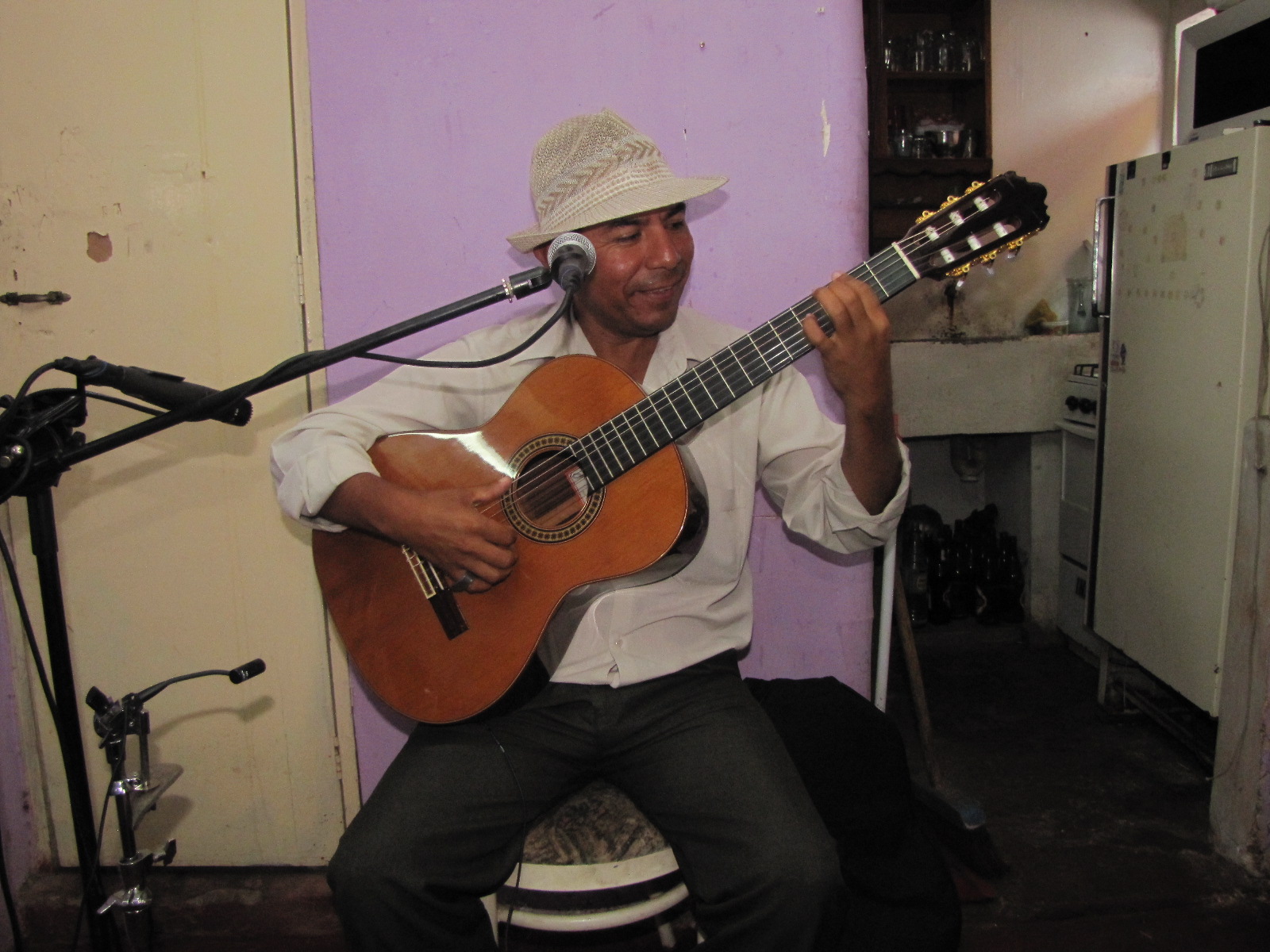
In April of 2010 Secret Stash Records traveled to Lima, Peru and assembled Pena, an Afro-Peruvian ensemble featuring a handful of the best musicians within the genre.  The group was a revolving door of sorts that included over a dozen players ranging in age from 24 to 65.  In seven days they recorded over 50 tracks.  With no access to a conventional recording studio they improvised by tracking in classrooms, living rooms, balconies, offices, and even on the stoop of a hostile.  The sessions were fast, free spirited, and generally consisted of one or two takes per track.  The result is an authentic display of one of the world’s most unique, unexplored and underrated musical styles.

Afro-Peruvian music was born directly out of the slave culture of costal Peru (approx. 1521-1856).  Each style or form of the genre reflects a different aspect of the life of slavery.  The distinguishing instrument of Afro-Peruvian music is the cajón, a large wooden box drum.  The first cajónes were nothing more than dresser drawers and fruit boxes used by slaves as drums.

For nearly 100 years Afro-Peruvian music and culture slowly withered away until the 1950’s when a small group of people in the village of El Carmen began a revival movement.  Over the following decades, Afro-Peruvian music began to thrive on a much larger scale.  By the 1970s Lima became the epicenter of its rediscovery.  Until now, outside of Peru, this music had received very little recognition or notoriety.  Only a small handful of Afro-Peruvian records are available abroad today.
 

Peruvian Funk LP due out 10/19/10 (yellow vinyl)

In April of 2010, Secret Stash Records traveled to Lima, Peru in search of music to bring back to the U.S. and share with the world.  While down there, we asked everyone we talked to about Peruvian funk music.  No one had any idea what we were talking about.  They didn’t even know what funk was. The few people who thought they knew what it was had no recollection of any Peruvian Funk ever existing.  Convinced that some form of funk had to exist in Lima during the 70s, and determined to find it, we continued to inquire everywhere we went.  After much searching, we finally stumbled over some by total accident.

A local man was helping us sort through stacks of records in a run-down garage when he handed me a pile of what he called rock records.  Most of the stuff was psych and pop from the 60s and 70s.  But, as it turned out, a few were straight up funk.  Apparently, they had funk in Peru during the 70s, Peruvians just didn’t know that’s what it was called.

Peruvian Funk brings together the funkiest cuts we found that day in Lima on one compilation.  The mix of Latin jazz, soul, and hard funk found in these recordings makes for one of the most fun records we’ve ever had the pleasure of releasing.  We hope you enjoy it as much as we do.

Haze

Secret Stash Records is helping to distribute the album, Haze: When We Were Kids
In 1974 Minneapolis R&B outfit, Haze, released their debut self-titled album. The lead single, “I Do Love My Lady” became a regional smash hit reaching number 38 on the Billboard R&B Chart in early ‘75. It’s been hailed by local music critics as one of the best of a long list of lost and forgotten pre-Prince Minneapolis R&B hits. Later that year, frustrated with the poor distribution of their LP by ASI Records, they traveled to L.A. where they scraped together some money and funded the recording of 6 songs in the RCA studio. On their way out of the building, they were stopped by a man claiming to be an A&R rep who was interested in their sound. He took them out to lunch to talk business. Eventually he excused himself from the table to use the restroom. After he was gone for ten minutes, the band realized he had snuck out the back door through the kitchen and taken their master tapes with him. To date there has been no indication of the recordings ever surfacing. Later that year the band was offered a recording contract with Factors, Etc. and moved to Delaware to record a new album. There was a dispute with the owner of the label, the band was sent home and all the members went their separate ways. The album was never completed.

In mid 2007 a radio DJ from Mankato, MN purchased a massive stack of LPs from a private seller in Minneapolis. Included in that stack was a white label test pressing that she dubbed, “The Mystery Record.” After years of relentless work and investigating, she discovered that it was in fact the first Haze LP. She had never heard of the band before and was hard pressed to find a single living soul who could give her any information about them. Her search for the band created a massive local buzz and decades after they had all moved on to different careers, the band was thrown back in the spotlight. Local print publications and radio programs went nuts for the story. Word has spread about these forgotten heroes of funk and now music fanatics everywhere want the first Haze LP and it’s almost impossible to find. Used copies regularly sell for over $200 on ebay to buyers around the globe.

“When We Were Kids” is the same album as their self titled debut with a new name and artwork. This CD reissue is the first installment of the group’s reintroduction to the world of music retail. They have a completed unreleased lost album circa ’76 that will be reissued soon as well. Vinyl pressings of both albums will be released later this year.

Getting To The Roots Of Afro-Peruvian Culture


On 4/15/10 we met up with Miki Gonzalez and the Ballumbrosio twins (sons of the infamous Amador Ballumbrosio) in Miki’s studio in Lima, Peru.  Miki (one of Peru’s biggest rock stars) offered some incredible insight into Afro-Peruvian music and the Ballumbrosios showed us the dances that are truly at the root of Afro-Peruvian music and culture.  Miki is the twins’ godfather.  He is one of the first (and only) non-Africans to be accepted into El Carmen in such an intimate way.  The twins’ father, Amador Ballumbrosio is widely considered to be the godfather of the Afro-Peruvian revival.  Miki explained how it was an incredible thing for us to learn the Zapateo (an Afro-Peruvian dance) directly from the twins.  He said we were getting our masters degree in Zapateo.

When Miki heard we were in town and what we were up to, he instantly invited us out to his studio.  It seemed as though everyone we came across in Lima was completely thrilled to share what they could of Afro-Peruvian music with us.  Miki and the twins were no exception.  This video is just a tiny little peek at the time we spent with them.  We hope you enjoy it!

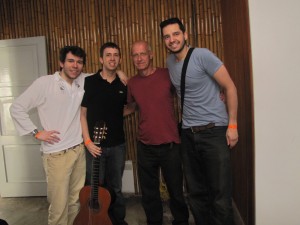
Unai, Cory, Miki, and Eric

Music, an important part of Peruvian culture

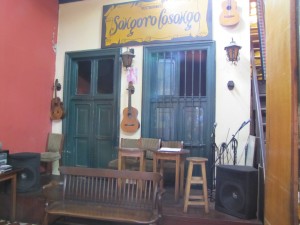
Songoro Cosongo

On our first day in Lima we stopped off for some mid-day ceviche and pisco sours in a small local restaurant that was built right off of the owner’s house.  He came out right after we ordered and chatted with us for a while.  We told him what we were in town for and that Cory plays Afro-Peruvian music.  He pulled a guitar off the wall that we were sure was only there for decoration and asked Cory to play for him.  Cory started playing a Festejo and the shop owner quickly joined in singing and even playing the cajon.  Then he and Cory played a classic Cuban Son (a form of Cuban folk music) together and all the other customers in the restaurant joined in.

Technically speaking, what we witnessed that afternoon was nothing special to speak of.  What moved us in a very profound way was the realization that music is so tightly woven into the fabric of their culture.  It was all about feeling good and enjoying the moment together with those around, even if they were strangers.  This would be the first of many examples we’d witness first hand that illustrates this cultures love of music.  It was one of the most fun experiences of our lives.  Check out this video clip to see it for yourself.